
 |
|
|
When the 9n Fords appeared in the late thirties they were perhaps one
of the most important technological developments in America. This little tractor
increased a man's productivity on the farm by multiples. More modern tractors
are available now, but they cost much more, and are really only a refinement
of Henry Ford's and Harry Ferguson's solid, basic idea. What set it apart from
it's rivals of the time was a simple hydraulic system that makes all sorts of
attachments practical: posthole diggers, cement mixers, mowers, blades, scoops,
chippers, plows, rakes, etc. The engine is basically a Model A Ford, probably
of 20 hp or so. The 9N Ford should be in antique shows because of its age,
many are, but most are still in use today.
The 9N, 2N and 8n Ford tractors made a major
contribution to American farm history.
Parts are readily available from many sources at this time. Go find one of the
old
used Ford Tractors and give it a home.
|
|
|


The story of the deal between Henry Ford and Harry Ferguson, which was sealed with
only a handshake, has been told so many times by so many people that no one is
exactly sure how it happened. Basically, Harry Ferguson invented the three-point
hitch and Ford agreed to put it on his new Ford 9N tractor. Called the "Ferguson
System", this three-point hitch was put together using a combination of linkage
(three different linkage points, two on bottom and one on top) and hydraulics.
It used to be that hooking up an implement to a tractor was a major affair.
Farmers had hoists and helpers and all kinds of inovative ways to get that
heavy thing hooked up. With the Ferguson System they need only back up to the implement,
hook it up, raise it with the hydraulics and off they went. |
The Handshake |
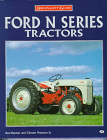
The Ford 9N - 1939 to 1941 The Ford 9N, the first of the "N Series" tractors was born complete with the first three-point hitch in 1939. It was developed as a versatile all-purpose tractor for the small farm and was exceedingly popular. It went through subtle changes almost every year of production. For example, in 1939 the grille had nearly horizontal bars and the steering box, grille, battery box, hood, instrument panel and tranny cover were made of cast-aluminum. It had snap-on radiator and fuel caps. In 1940 these caps were changed to the hinged type. In 1941 they changed the grill to steel with vertical bars. Many other changes were made and if you are interested you may want to purchase a Ford history book that focuses on the N Series. By the end of 1941 they had made so many changes, and had so many more ideas for changes, that they changed the name of the tractor to the "Ford 2N". The Ford 2N - 1942 to 1947 Some of the newest features on the Ford 2N were an enlarged cooling fan (with shroud), a pressurized radiator, and eventually sealed-beam headlights. Other changes were made here and there due to the war. For awhile only steel wheels were available, and a magneto system was used rather than a battery. When the war ended it went back to what it had been before. The Ford 8N - 1947 to 1952 The Ford 2N eventually evolved into the Ford 8N, which officially started it's production, and they had new tractors for sale in 1947.This was also the year the handshake agreement between Henry Ford and Harry Ferguson was ended regarding the three-point hitch. Ford would continue using the hitch, but would no longer give Harry any money nor would he call it the "Ferguson System" any longer. This resulted in a lawsuit which eventually awarded Harry Ferguson $10 million or so. Harry went on to produce the 8N look-alike TO-20 and TO-30 A completely new line of implements (Dearborn) was introduced. Some of the noticeable differences between the 9N/2N was the change in lugs from six to eight in the rear wheels, scripted "Ford" logo on the fenders and sides of the hood (reportedly this scripting did not actually start until late 1950) and finally, the absence of the "Ferguson System" patch which was no longer displayed under the Ford oval (even though the tractor still used Fergusons three-point hitch). |
Perhaps one of the most important technological developments in American Farm History
9N, 2N, and 8N Ford Tractors were ahead of their time |